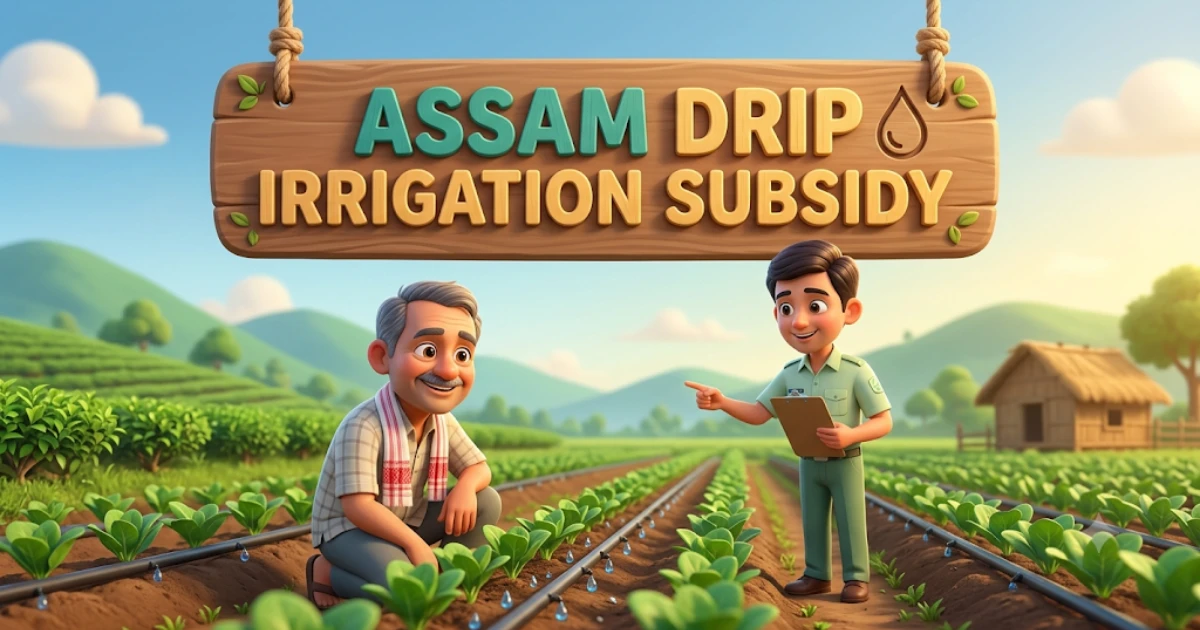
My uncle grows vegetables on about six bigha of land near Nagaon, and last winter he was seriously considering drip irrigation after two bad monsoons in a row. What stopped him wasn’t the idea it was the money. He’d heard “government subsidy” mentioned by someone at the block office, but nobody could tell him a clear number. Was it 50%? 60%? Did tea gardens get a different rate than a small vegetable farmer? He ended up shelving the plan for a season just because the numbers felt too vague to commit to.
That’s the gap this article is trying to close. Here’s what the Assam government actually pays toward drip and sprinkler irrigation right now, how the split works between small farmers and large estates, and a calculator to work out your own numbers before you talk to a supplier.
What this subsidy actually covers
Assam’s Agriculture Department runs micro-irrigation support under two overlapping schemes — PMKSY-PDMC (Pradhan Mantri Krishi Sinchayee Yojana, Per Drop More Crop), which is the central scheme, and CMSGUY (Chief Minister Samagra Gramya Unnayan Yojana), the state’s own top-up. Together they fund drip and sprinkler systems for farmers, so that watering a field doesn’t mean waiting on rainfall or running a diesel pump for hours.
The subsidy isn’t a loan and it isn’t paid back. It reduces what you owe the installation company directly.
Assam PMKSY subsidy rates 2026
The Assam PMKSY micro irrigation subsidy calculator most farmers are looking for comes down to this table:
| Farmer Category | Farm Size | Govt Subsidy | Centre + State Share |
|---|---|---|---|
| Small & Marginal Farmers | Up to 5 Bigha (2 Hectares) | 85% | Centre 50% + Assam State 35% |
| Large Farmers & Tea Estates | Above 5 Bigha | 80% | Centre 50% + Assam State 30% |
Notice the split isn’t about how much land you farm in isolation — it’s a threshold. Cross 5 bigha and the rate drops by 5 percentage points, on the whole system, not just the extra land above the line.
₹45,000 per bigha
That’s the benchmark cost the Assam Agriculture Department uses for a standard drip or micro-sprinkler installation, and it’s the number the whole calculation is built on. Actual quotes from suppliers can run a little above or below this depending on the terrain and system type, but this is the figure used to work out your subsidy amount.
How the calculation works
Three steps, in order:
- Multiply your farm area in bigha by ₹45,000 to get the gross system cost
- Apply your subsidy rate — 85% for small/marginal, 80% for large farms and tea estates
- Subtract the subsidy from the gross cost to get what you actually pay
Worked example — small farmer
Farm area: 5 Bigha
Gross system cost: 5 × ₹45,000 = ₹2,25,000
Subsidy (85%): ₹1,91,250
Farmer’s share: ₹33,750
Now compare a tea estate with 10 bigha under micro-irrigation:
Worked example — tea estate
Farm area: 10 Bigha
Gross system cost: 10 × ₹45,000 = ₹4,50,000
Subsidy (80%): ₹3,60,000
Farmer’s share: ₹90,000
My uncle’s six bigha, if he’d gone ahead, would actually have crossed into the 80% bracket rather than 85% — which is exactly the kind of detail that gets missed when you’re going on word of mouth instead of doing the math.
How to Use the Calculator
Step 1. Select your farmer category — Small & Marginal Farmer (85% subsidy) or Commercial / Tea Estate / Large Farm (80% subsidy).
Step 2. Enter your farm area in Bigha.
Step 3. Click “Calculate PMKSY Irrigation Subsidy.”
Step 4. You’ll instantly see your total system cost, your government subsidy amount, and your exact out-of-pocket share.
Documents and eligibility
Eligibility for drip irrigation subsidy in Assam isn’t limited to landowners with a title deed in their own name. Tenant farmers with valid land agreements qualify too, and so do tea garden owners registered with the Assam Agriculture Department.
To apply, you’ll typically need a Jamabandi or Land Patta copy, Aadhaar card, bank passbook, Voter ID, and passport-size photographs, all submitted to your District Agriculture Office (DAO).
Some things people ask us often
How much subsidy does Assam Government give for drip irrigation?
Small and marginal farmers get 85% government subsidy on drip and sprinkler systems under PMKSY-PDMC, while large farmers and tea gardens receive 80%.
Who is eligible for PMKSY drip irrigation subsidy in Assam?
Any farmer owning agricultural land in Assam, tenant farmers with valid land agreements, and registered tea garden owners.
Is CMSGUY the same as PMKSY, or a separate scheme I need to apply for separately?
They run alongside each other rather than as one single application. PMKSY-PDMC is the central scheme; CMSGUY is Assam’s own state-funded addition on top of it. In practice, your DAO handles the paperwork under one umbrella process, so you don’t file two separate applications for the same irrigation system.
What documents are required to apply for PMKSY irrigation subsidy in Assam?
Jamabandi / Land Patta copy, Aadhaar card, bank passbook, Voter ID, and passport-size photographs, submitted to the District Agriculture Office.
Are tea gardens in Assam covered under micro-irrigation subsidies?
Yes. Small and commercial tea growers can avail up to 80% government subsidy for installing micro-sprinkler and drip networks.
Is this an official government calculator?
No. This is an independent tool built using the Assam Agriculture Department’s published subsidy rates and benchmark cost, so you can work out a realistic estimate before approaching a DAO or an installation company. The final subsidy amount is confirmed only after DAO verification and approval — this calculator gets you close, not exact.
Official Resources
Subsidy rates, benchmark costs, and empaneled company lists do get revised, so it’s worth checking directly rather than relying only on word of mouth:
If you’re planning to apply, the first real step isn’t picking a supplier — it’s a visit to your District Agriculture Office to confirm your category and get the current list of registered micro-irrigation companies for your district.